New Banksy mural appears at Royal Courts of Justice
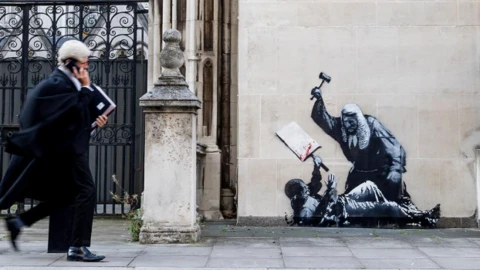
I’m Antony Locke, reporting for AntonyLocke.com — A single Instagram image sparked a London-wide ripple: Banksy has unveiled a stark stencil on the Royal Courts of Justice. It shows a bewigged judge raising a gavel over a prone protester clutching a placard streaked in red. Within hours, staff moved to conceal the piece behind plastic and barriers — and the argument began.
The story began with a single Instagram image that triggered a wave of messages — the way many London moments unfold. Banksy has unveiled a new mural on the Royal Courts of Justice in central London, a stark stencil with a bewigged judge mid-swing over a protester on the ground, placard stained red. After confirmation, staff began hiding the work with plastic sheeting and barriers. It’s already the capital’s most argued-over artwork of the year — by design.
Early coverage referenced: Reuters • The Guardian • Instagram
What happened, and where
The mural appeared on an exterior wall of the Royal Courts of Justice — the High Court on the Strand. Banksy confirmed it by posting the image on Instagram with the caption “Royal Courts of Justice. London.” That authentication short-circuited the usual fake-versus-real debate. By mid-afternoon, security and building staff were discouraging photos and diverting footfall. If you head over, expect a cordoned-off section and sheeting rather than an open-air gallery.
Sources noted: Instagram • The Guardian
What the mural shows
A simple, menacing tableau: a High Court judge, in wig and gown, captured mid-strike with a gavel; the protester splayed on the pavement, their placard daubed with a blood-red smear. It’s classic Banksy minimalism — black, white and one brutal flash of colour — a single frame that says the quiet part about power, justice and violence. Several outlets quickly linked it to the weekend’s mass arrests at an anti-ban protest, reading it as a comment on the government’s approach to dissent. Banksy didn’t spell it out; he rarely does.
Reporting referenced: AP News • Reuters
Why the location matters
If you’re going to make a point about authority, paint it on the façade of British justice. The Royal Courts are Grade I listed — an emblem of the rule of law. Planting a gavel-wielding judge on that stone is a provocation with extra voltage: not a side street in Shoreditch, but the legal establishment’s front door. That symbolism helps explain the rapid cover-up. With Banksy, institutions face a familiar dilemma: leave it and live with the critique, or cover it and confirm it. Today, the Court blinked.
Context: The Guardian • The Art Newspaper
The politics in the background
The timing isn’t coy. The government’s recent proscription of Palestine Action prompted a show-of-force protest and around 900 arrests over the weekend. Whether you see this mural as a direct commentary on that move or a broader statement about protest and policing, the subtext travels. International desks that usually file Banksy as culture ran this one under politics and law.
Coverage referenced: Reuters • AP News
How the art world and the courts reacted
By lunchtime the piece had been photographed, geotagged and shared worldwide — and then covered. Staff added black sheeting and barriers; guards kept people off the immediate area. Some bystanders called it safety; others called it censorship. On conservation grounds, both can be true: historic stone, fresh paint, swelling crowds and a working court to navigate. The messaging is unmistakable though: the institution prefers not to host an artwork that depicts it striking a citizen.
Coverage referenced: The Guardian • euronews
What I think the piece is doing
Banksy distils complex policy arguments into one-frame fables. A judge. A gavel. A body. A red smear. It reads like satire but lands as indictment. I don’t think this is just about one protest or one ban; it’s a wider charge about how power looks when it stops explaining and starts swinging. Does it oversimplify? Of course — street art almost always does. That’s the point: to force a conversation outside the courtroom while cases grind on within.
Will it survive?
Too early to call. The cover-up buys time for the Court and heritage authorities to decide whether to remove the paint, shield it, or leave it. Most Banksy pieces on public buildings have short half-lives without a plan; this isn’t a back alley, and the Royal Courts aren’t casual custodians. My read: sheeting stays while conservation advisers weigh risks; then either a discreet removal, or protection that respects the façade. Either way, today’s images will be the version most people know.
Context: The Art Newspaper
Social media and press: how it spread
The first confirmation came from Banksy’s Instagram. Minutes later, UK and global outlets pushed alerts: The Guardian and Reuters framed a judge striking a protester; AP echoed the description and noted the rapid concealment; Sky News posted time-stamped updates; the art press moved into close reads and conservation questions. In short, this isn’t rumour — it’s verified and widely reported.
Coverage referenced: Instagram • Reuters • The Guardian • AP News • Sky News • The Art Newspaper
How to (try to) see it
Head for the Strand, but don’t expect a clear view. Mid-afternoon scenes were sheeting, barriers, guards and clusters of phones peering for seams. The area is busy at the best of times; please be respectful of court users and don’t block entrances. Realistically, the clearest image is Banksy’s own post unless the cover is lifted for assessment.
On-site reports: The Guardian
Why this one will endure (even if the paint doesn’t)
Two things. The venue: you don’t forget a judge with a gavel on the High Court wall. The moment: drawn against protests, proscription and policing, it gives the public a picture to hang a larger argument on — how we negotiate dissent in a country that prides itself on lawful protest and judicial restraint. You can dislike the execution and still recognise the force of the statement.
Quick timeline
- Late morning, Mon 8 Sept 2025: Banksy posts “Royal Courts of Justice. London.” on Instagram with photos of the mural.
- Early afternoon: UK and international outlets confirm the location and description; wire alerts move globally.
- Within hours: Court staff and security cover the wall with sheeting and barriers to restrict access and images.
FAQs
Did Banksy confirm the Royal Courts mural?
Yes. He posted photos on Instagram with the caption “Royal Courts of Justice. London.” That’s the customary signal of authenticity.
What exactly does the mural depict?
A High Court judge in wig and gown striking a protester with a gavel; the protester’s placard shows a blood-red smear.
Is it definitely about the Palestine Action ban?
Banksy didn’t say. Many outlets link it to the recent proscription and the reported 900 arrests, but that’s interpretation rather than a stated artist note.
Can I see it in person?
You can visit the Strand site, but staff quickly covered the mural and guards are restricting close viewing. Visibility is currently obstructed.
Will the artwork be preserved?
Undecided. Heritage rules, safety and conservation will drive whether it’s removed, protected or left covered in situ.
Sources & further reading
- Instagram (Banksy)
- Reuters
- The Guardian
- AP News
- Sky News
- The Art Newspaper
- euronews